service@chemindustry.com

|
 |
|
|
|
 |
News Details |
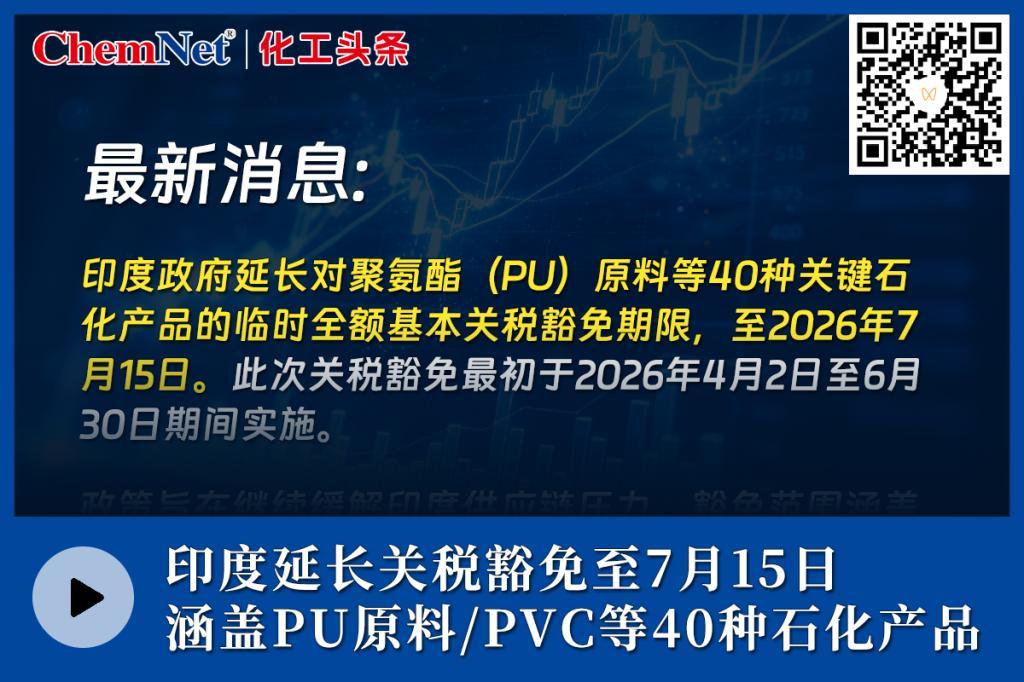

Recently, the Central Board of Indirect Taxes and Customs (CBIC) under India's Ministry of Finance officially issued an announcement, extending the full exemption period for basic customs duties on polyurethane (PU) raw materials and several key petrochemical products by another 15 days, with the latest policy valid until July 15, 2026, to continue alleviating pressure on the domestic chemical supply chain and help downstream manufacturing industries stabilize operating costs.
This extension policy was implemented on June 30, 2026, through two official customs notifications, No. 22/2026-Customs and No. 23/2026-Customs, accompanied by two official gazette notifications, G.S.R. 528 (E) and G.S.R. 529 (E).
The documents clearly state that the previous policy expiration date of June 30, 2026, is directly replaced with July 15, 2026. Importers can continue to enjoy full exemptions on basic customs duties for relevant categories within the validity period of the new regulations, provided that the relevant import activities do not trigger other trade control measures.
Looking at the policy timeline, this customs duty exemption was first announced via Notifications No. 12/2026-Customs and No. 13/2026-Customs on April 1, 2026. The policy was officially implemented starting April 2, 2026, with an original exemption cycle from April 2 to June 30. Given the high dependence of India's PU industry on raw material imports and the persistent fluctuations in the global petrochemical supply chain, the Indian government chose to temporarily extend the period by 15 days to continue the relief measures on import costs.
The products enjoying full customs duty exemption this time are primarily core raw materials in the polyurethane industry chain, specifically including key petrochemical categories such as toluene, TDI, MDI, polyether polyols, and polyurethane systems. These raw materials are core production inputs for several pillar industries in India, including automotive manufacturing, construction insulation, home furniture, and daily consumer goods. The customs duty exemption can effectively reduce the landed cost procurement of raw materials and maintain the operational enthusiasm of downstream industries.
India Customs also clarified that this temporary exemption applies only to basic customs duties, while existing anti-dumping related trade policies remain unchanged. Relevant products are still required to pay corresponding anti-dumping duties according to rules of origin. The customs duty exemption and anti-dumping taxation measures are implemented in parallel and do not replace each other.
Industry analysis indicates that this short-term 15-day extension not only provides a buffer window for domestic downstream manufacturing enterprises in India for raw material procurement and inventory stockpiling but also reserves observation time for the Indian government to subsequently assess global raw material supply and demand, the domestic chemical industry supply and demand pattern, and evaluate the normalization of tariff policy adjustments.
From:ChemNet

|
Recommended Suppliers |